Agentic AI vs Traditional Automation: What Companies Need to Know
“Agentic AI” describes AI systems that can plan, make decisions and take actions toward a goal with limited supervision. It is a big step beyond the rule-based automation most companies already run — but it is not the right tool for everything. This guide compares the two and shows how to adopt agentic AI safely.
Traditional automation in one paragraph
Rule-based automation and RPA follow explicit instructions: if this field equals X, do Y. They are fast, cheap and predictable, which makes them ideal for structured, stable processes. Their weakness is change: a new email format, a different invoice layout or an unexpected request breaks the flow.
What makes AI “agentic”?
- Goal-driven: you describe the outcome, not every step.
- Reasoning: it decides what to do next based on context.
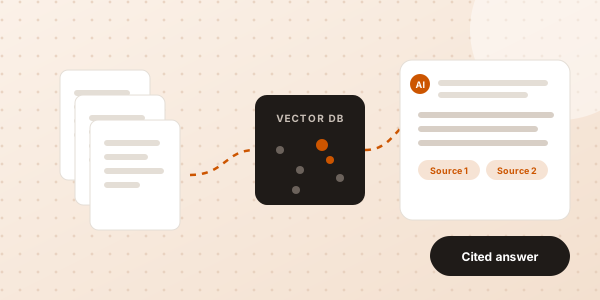
- Tool use: it calls APIs, searches data and updates systems.
- Adaptability: it handles unstructured inputs like emails, chats and documents.
- Collaboration: several agents can work together in a multi-agent system.
Side-by-side comparison
| Traditional automation | Agentic AI | |
|---|---|---|
| Best for | Structured, repetitive tasks | Messy, judgement-based tasks |
| Inputs | Fixed formats | Text, documents, conversations |
| Handles change | Poorly | Well |
| Predictability | Very high | Needs guardrails and review |
| Running cost | Low | Moderate (model usage) |
When to use which
Use traditional automation for moving data between systems, scheduled jobs and anything with strict rules. Use agentic AI when a task needs reading, interpreting or deciding — triaging support tickets, researching leads, reviewing documents or coordinating several steps across tools. The best systems combine both: agents make decisions, and deterministic automations carry them out.
Rolling out agentic AI safely
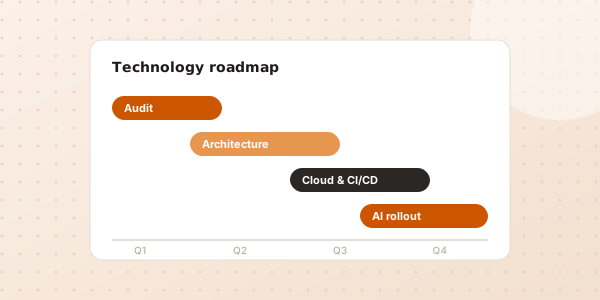
- Start narrow: one workflow, clear success metrics.
- Least privilege: give each agent only the access it needs.
- Human in the loop: require approval for payments, external emails or data deletion.
- Observe everything: log prompts, tool calls and outcomes.
- Govern: set AI usage policies and audit regularly — tools like our AI Governance Manager Plugin help.
Agentic AI setup for companies
Cardzo helps companies worldwide design and deploy agentic AI — workflow analysis, agent design, integration, testing and handover — using tools like LangChain, n8n and the OpenAI API. See our Agentic AI Setup work or get a quote.
Frequently asked questions
Will agentic AI replace RPA?
Not entirely. Rule-based automation stays the cheapest, most reliable option for structured tasks. Agentic AI adds value where judgement and unstructured inputs are involved.
Is agentic AI ready for enterprise use?
Yes, for well-scoped workflows with guardrails, monitoring and human approval on high-impact actions.
What frameworks are used to build agentic AI?
Popular choices include LangChain, LangGraph, n8n and custom Python services built on models from OpenAI, Anthropic or others.