What Are AI Agents? A Practical Guide for Businesses
“AI agents” has become one of the most-searched technology terms of the past year, and with good reason. Where a chatbot answers questions, an AI agent gets work done: it reads a request, decides what to do, uses your business tools and reports back. This guide explains what AI agents are, where they create real value, and how to start your first project with sensible expectations.
What is an AI agent?
An AI agent is software that uses a large language model (LLM) as its “brain” to reason about a goal and take actions to reach it. Every agent has three building blocks:
- Reasoning – the LLM breaks a goal into steps and decides what to do next.
- Tools – connections to your systems: CRM, email, calendar, databases, spreadsheets, internal APIs.
- Memory – context about the task, the customer and previous steps so the agent stays consistent.
Put together, an agent can handle a task such as “qualify this new lead, enrich it with company data, draft a personalised reply and book a call if they are a good fit” — end to end, with a human approving only the final step if you want.
AI agents vs chatbots vs traditional automation
Traditional automation (scripts, RPA, Zapier-style flows) follows fixed rules and breaks when inputs change. Chatbots talk but rarely act. AI agents sit in between: they handle messy, unstructured inputs like emails, PDFs and free-text requests, and they can choose different actions depending on the situation. We go deeper on this in Agentic AI vs traditional automation.
Real business use cases
- Sales: lead qualification, research on prospects, personalised follow-ups and CRM updates.
- Customer support: answering common tickets from your knowledge base (often using a RAG pipeline) and escalating the rest with a summary.
- HR & recruitment: matching candidates to roles and tailoring CVs — the idea behind our Job Agent & CV Builder.
- Operations & finance: reading invoices, reconciling data across systems and preparing weekly reports.
- Content: turning briefs into first drafts, decks and social posts — see our PowerPoint AI Generator.
Single agents vs multi-agent systems
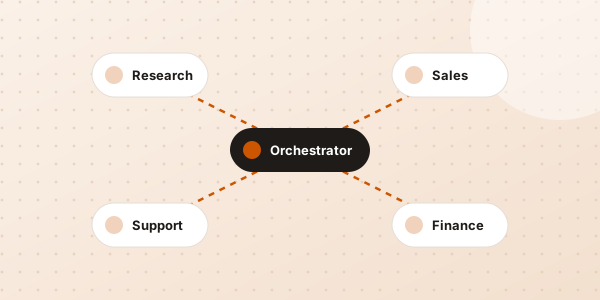
Simple tasks need one agent. Larger workflows work better as a team of specialised agents — for example a research agent, a writing agent and a reviewer — coordinated by an orchestrator. Multi-agent systems are more reliable for complex work because each agent has a narrow, testable job.
What does it take to build an AI agent?
- Pick one workflow that is repetitive, high-volume and well understood by your team.
- Map the steps and tools involved, including where a human must approve.
- Build a pilot with a modern framework (LangChain, n8n or a custom Python service) and connect only the tools it needs.
- Test on real examples, measure accuracy and time saved, and add guardrails.
- Roll out gradually, monitor every action and improve prompts and data over time.
Risks to manage
Agents can make confident mistakes, so good projects include human approval for high-impact actions, strict permissions on what each agent can access, logging of every decision, and clear policies for sensitive data. Our open-source AI Governance Manager Plugin exists exactly to help teams audit and monitor AI usage.
How Cardzo can help
We design, build and deploy AI agents and multi-agent systems for companies worldwide — from workflow analysis to integration, testing and handover. If you have a process that eats hours every week, it is probably a good first candidate. Get a quote or read about our services.
Frequently asked questions
Are AI agents safe to use with business data?
Yes, when they are built with limited permissions, human approval for important actions, logging and clear data policies. Good design matters more than the model you choose.
How long does it take to build an AI agent?
A focused pilot for one workflow often takes a few weeks. Larger multi-agent systems connected to several business tools usually take a few months.
Do I need my own AI model?
Usually not. Most business agents use existing models such as those from OpenAI or Anthropic, combined with your data and tools.