Native vs Cross-Platform App Development: How to Choose
One of the first decisions in any mobile app development project is how to build it: separate native apps for iOS and Android, or one cross-platform app that runs on both. The right answer depends on your product, budget and timeline.
Native development
Native apps are built with each platform’s own tools — Swift for iOS and Kotlin for Android.
- Pros: best possible performance, immediate access to new platform features, the most “at home” feel.
- Cons: two codebases, two teams or skill sets, and roughly double the effort to build and maintain.
Cross-platform development
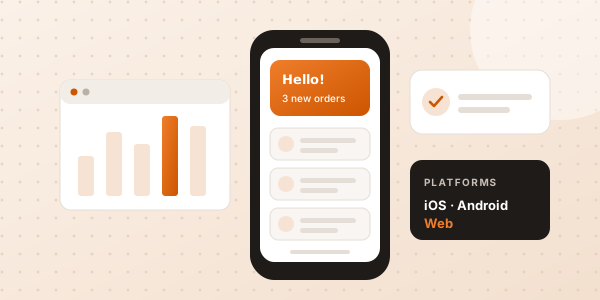
Frameworks like React Native and Flutter let one codebase power both iOS and Android — and often the web as well.
- Pros: faster time to market, lower cost, one team, consistent features across platforms.
- Cons: very graphics-heavy apps or deep hardware integrations may need some native code.
React Native vs Flutter
| React Native | Flutter | |
|---|---|---|
| Language | JavaScript / TypeScript | Dart |
| Best when | You have web (React) skills or a React web app | You want highly custom, pixel-perfect UI |
| Code sharing with web | Strong | Good |
| Ecosystem | Very large | Large and growing |
How to choose
- Choose cross-platform for most business apps, marketplaces, portals, booking and internal tools.
- Choose native for games, advanced AR/camera apps or apps that rely on the newest OS features.
- Consider a web app first if you need to validate an idea quickly — like our Timesheet Portal for small businesses.
Plan beyond the build
Budget for app store setup and review, analytics, crash reporting, security updates and new OS versions every year. AI features — chat assistants, smart search, document scanning — can be added via APIs, and RAG lets an in-app assistant answer from your own content.
Build your app with Cardzo
We design and build cross-platform mobile and web apps from UX to launch and support. See our app development work or get a quote.
Frequently asked questions
Is cross-platform app development cheaper?
Usually yes, because one codebase serves iOS and Android, which reduces build and maintenance effort compared with two native apps.
Can a cross-platform app feel native?
Yes. Modern React Native and Flutter apps use native components or high-performance rendering, and most users cannot tell the difference.
How long does it take to build a mobile app?
A focused MVP often takes a couple of months; feature-rich apps with integrations take longer. A discovery phase gives you a reliable timeline.